Sunday, May 6, 2012

Fresh mosses!

After three months of looking at dried specimens, it was refreshing to take a hike and look at some FRESH mosses. It's been rainy the past week and everything was lush. Many of the Plagiomniums and Atrichums had new leaves which were a nice light green compared to last years leaves. The first stop on my hike was near a limy boulder. The side was covered with Mnium marginatum and below that was Anomodon rostratus looking like a pile rug:


On the top of the boulder was a nice patch of Rhodobryum ontariense, very nicely opened with the wet weather. Its older name of Rhodobryum roseum seems much more appropriate with its nice rose-like growth form.


 All over the ground, tops of boulders, covering logs was the fern-like moss, Thuidium delicatulum: 

The next stop was on a powerline cut and the Polytrichums were wonderful! If you want to look at several kinds of Polytrichums, a powerline is the place to be. 

Polytrichum juniperinum is shown here next to Polytrichum pallidisetum. Note the nice silvery bluegreen of P. juniperinum on the left:


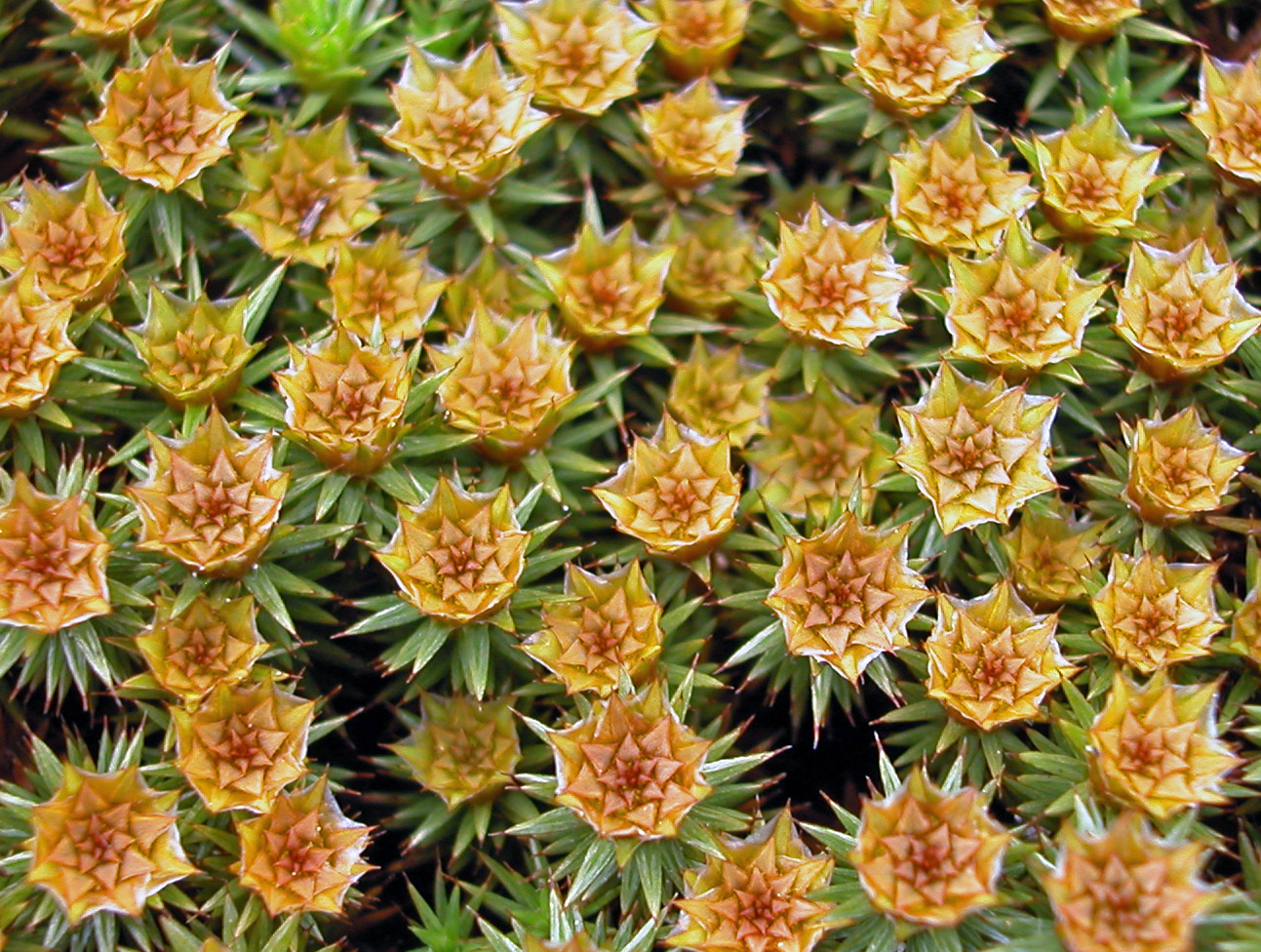
Here's a lovely picture of the male splash cups of P. juniperinum amongst some lichens on the top of a dry boulder:

Here's a close-up of the splash cups

Polytrichum piliferum has long, white hairpoints

A deep cushion of Polytrichum commune

And i couldn't help but notice all the other nice things happening in the woods:
All the ferns were unfurling

Saw several nice patches of the downy rattlesnake plantain.
Goodyera pubescens

Who doesn't love Jack-in-the-pulpit?

Lots of sweet white violets, Viola blanda

And, unfortunately lots of other, not so nice things are out this spring:
an adult female deer tick....yuck.
came back with 2 deer ticks and 2 dog ticks.


Thursday, March 29, 2012

Bryophytes in Second and Old Growth Forests

I'm interested in bryophyte communities...which bryos like to hang out together...not only, say on a log, but in an ecological community as well....in a rich fen, or in  an oak-hickory woods for example. The following two illustrations show a generalized 'map' of the commonly found bryophytes in a second growth woods and an old growth woods.

Common Bryophytes of Second Growth Hardwood Forests

Common Bryophytes of Old Growth/Rich Woods
One of the things you'll notice is that the diversity is greater in the old growth compared to second growth woods. Also, due to high amounts of leaf litter, there are virtually no bryophytes on the ground.  Of course there are many more species found than illustrated here, but these are the species you are likely to run into in  these areas.

In my next post, i'll show some maps from specific places.

Thursday, March 15, 2012

damn you

Atrichum crispum.......fooling me again into thinking you're some type of Mnium!

Monday, March 12, 2012

Atrichum crispulum, Atrichum altecristatum

Atrichum undulatum is what i had always called this plant. This is what is was in Crum's Mosses of Eastern North America. He had split it into several varieties: var altecristatum, var undulatum, var attenuatum, and var oerstedianum. i never bothered with these and just called the plant Atrichum undulatum. When i got my new copy of Flora of North America, i looked further into this species. It said: "No Atrichum species occurring in North America has been as widely misunderstood as A. undulatum....Its occurrence in North America has not been demonstrated. As used by American authors, it probably refers to A. altecristatum."  Atrichum crispulum had also been recently called Atrichum oerstedianum, but comparisons to the type specimen indicate that the two are separate with A. oerstedianum being found in Mexico and Central America.
So, ok, we don't have A. undulatum, what we DO have is A. crispulum and A. altecristatum from that complex. In working on my wooded wetlands project, i've come across several specimens and this is how to tell the two species apart...since i didn't have the exact substrate for the specimen (Apparently A. altecristatum prefers soil banks, along roads & trails, on hummocks - more like A. angustatum and A. crispulum prefers soil in mostly shaded habitats, often wet banks along streams or at the margins of fens or swamps), i had to make leaf cross sections to look at the height of the lamellae (which are the long ridges that are lined up along the costa). Almost all the specimens i looked at were A crispulum...it has 4-6 lamellae that are very short, usually they were 3 cells high. In A. altecristatum, the lamellae are 4-6 cells high. If you're lucky enough to collect a fruiting plant, A. crispulum has a capsule that is curved and inclined (see the photos and drawings below), whereas A. altecristatum capsule is usually more straight and erect.


Sunday, March 11, 2012

Trying to get back!

there is a reason i've been missing these last few months......

i have literally thousands of specimens to identify...this is one box of four, with each bunch having from 15-25 packets! This project concerns wooded wetlands, so there's a lot of repetition in the samples....
Lots of Thuidium delicatulum, Aulacomnium palustre, Hypnum imponens, Dicranum flagellare, Dicranum scoparium,Tetraphis pellucida, Leucobryum glaucum, Pallavicinia lyellii, Bazzania trilobata, Climacium, Atrichums, Rhizommium appalachianum, Calliergon cordifolium, Polytrichums and of course Sphagnums....over and over and over...lots and lots of Sphagnum palustre, S. fimbriatum, S. capillifolium, S. magellanicum, S. girgensohnii, S. subsecundum, S. fallax & flexuosum....a few times i've gotten the super nice S. wulfianum.
So, between work and identifying all these and trying to get a run or bike ride in has left little time for my book and blog! Luckily the specimens are good and not too scrappy. Plus it gets me thinking about the community of wooded wetland bryophytes. In my next post i'll talk some about the Atrichum undulatum complex.

Thursday, January 12, 2012

Our Common toothy leaved Polytrichums

Working on Polytrichum drawings today (including Polytrichastrum).
The following four species are our most common that have toothy leaves.
P. commune is the largest and if fruiting is easily told from all the others by it's shorter capsule with a large 'knob' at the base (see diagram). Polytrichastrum alpinum has a dark brown cylindrical capsule (separating it from  the other Polytrichums which have angled capsules. If P. alpinum is not fruiting, then you have to section the leaf and look at the lamellae. In this species the terminal or top-most cell is papillose, meaning it has little bumps all over it. The other Polytrichums in this group have smooth terminal cells. The other two species  are more difficult to tell apart. P. pallidisetum seems to prefer a moister woodland, whereas P. ohioense tolerates drier ground. P. pallidisetum is often quite large and is the typical woodland Polytrichum found in the hardwood forests. P. ohioense tends to be smaller and darker and replaces P. pallidisetum as you head toward the coast and get into oak-pine woods. Although they can often be found growing together. They have a similar long, angled capsule. P. pallidisetum does have a paler seta, especially towards the top, although young P. ohioense also has a pale seta. The only reliable way to tell the two apart is by doing sections of the leaf.  I cut off the leaf base and tips (so they lie nice and flat on the slide) and cut a lot of cross sections about mid leaf. Then i scrape the lamellae off so they lie flat on the slide - this is the best way to tell these two apart.

Lamellae x-section of Polytrichum pallidisetum

Lamellae x-section of Polytrichastrum alpinum - note papillose (bumpy) topmost cell


Polytrichastrum alpinum - dark brown, cylindrical capsule

Polytrichum commune
(J. Jenkins photo)

Polytrichum pallidisetum

Polytrichum ohioense